Security
Your keys stay with you
ArionPay is built so that even a full break-in on our servers cannot move your money. This page explains how, and where the limits are.
How it works
Seven layers, none of which needs your keys
Watch-only by design
- When you create a wallet, the 12 secret words are made in your browser and never sent to us.
- We receive only extended public keys. They can create receiving addresses and read balances, but cannot sign a transaction.
- The server refuses any request that contains a seed phrase or a private key.
Every payment matched to exactly one invoice
- Payments go to your wallet's main address, the one your wallet app shows (Trust Wallet, MetaMask, Exodus…), and each invoice has its own unique amount. No two open invoices share an amount, and each transfer is counted for one invoice only.
- Payments that reached the address before the invoice was shown never count for it.
- The exact amount is matched automatically. An amount within your tolerance (1% by default, 0 to switch it off) is matched only if it arrived while the invoice was open and no other unpaid invoice has a similar amount. Everything else waits for your decision, so an old, late or unclear payment is never credited to another customer.
Protected payout-wallet changes
- Adding your first wallet needs a code from your authenticator app; it works straight away.
- Adding or changing a wallet later also needs a confirmation link sent to your email.
- The new wallet becomes active only 24 hours after you confirm, and you can cancel the change until then.
Account protection
- Two-factor login with an authenticator app. Each code works once.
- Changing a wallet, showing the API secret, changing webhooks or marking an invoice paid needs a fresh code from your authenticator app, and always sends you a security email.
- Five wrong passwords lock the account for 15 minutes.
Tamper-evident audit log
- Every payment, address, webhook and account action is written to an append-only log.
- Each entry is chained to the one before it, and a signed summary of each day is stored outside the database.
- Any later change to the log shows up when it is verified, including changes made by an administrator.
Data and backups
- Personal data such as customer email and IP addresses is stored encrypted, with the keys kept apart from the data.
- Backups are encrypted with a key that is kept offline, and restores are tested.
- Personal data is anonymised after its retention period ends; payment records stay, without the personal details.
Signed API and webhooks
- API requests are signed with HMAC-SHA256 over a timestamp and the body; requests older than 5 minutes are refused.
- Webhooks are signed the same way with a separate secret, so your server can check where they came from.
Payouts
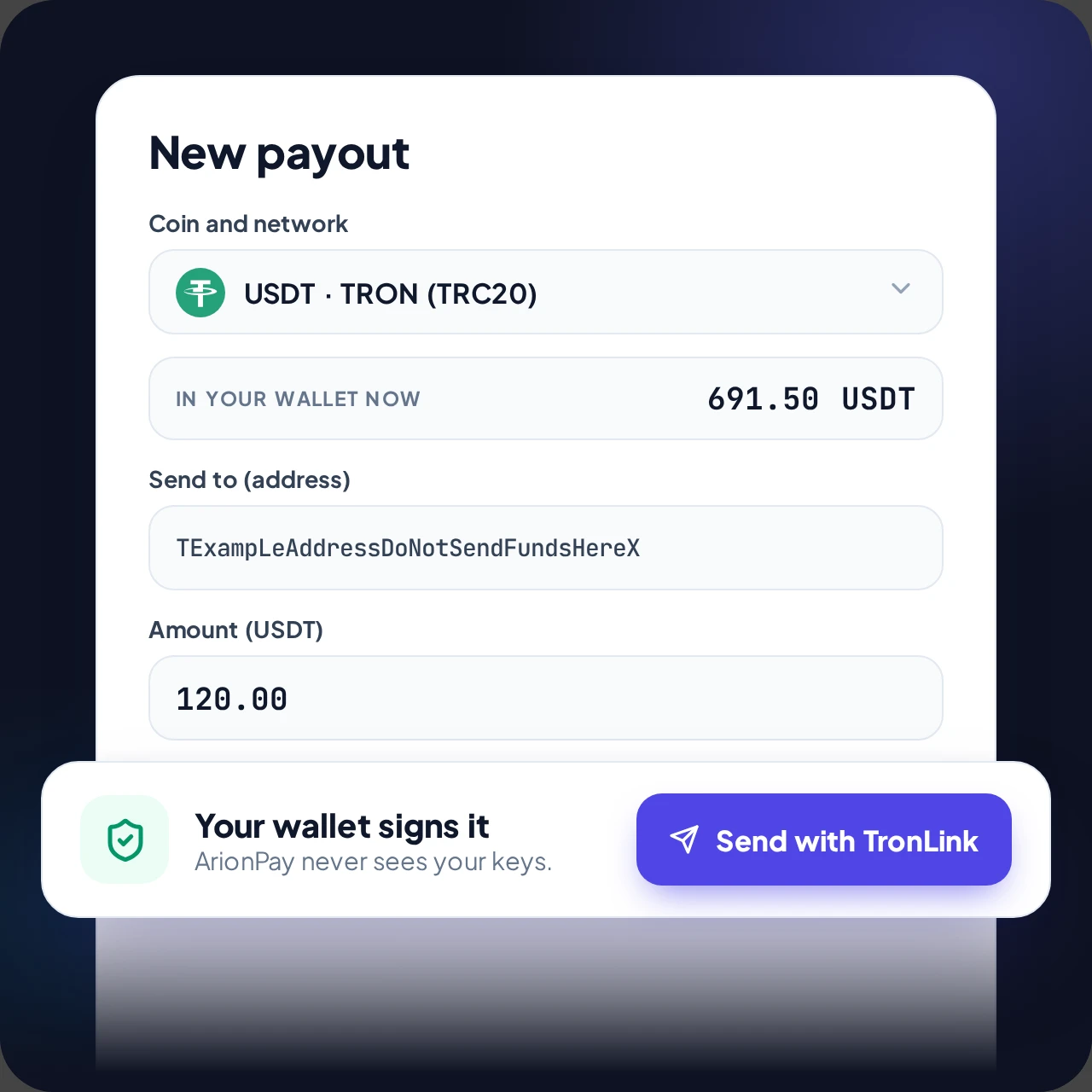
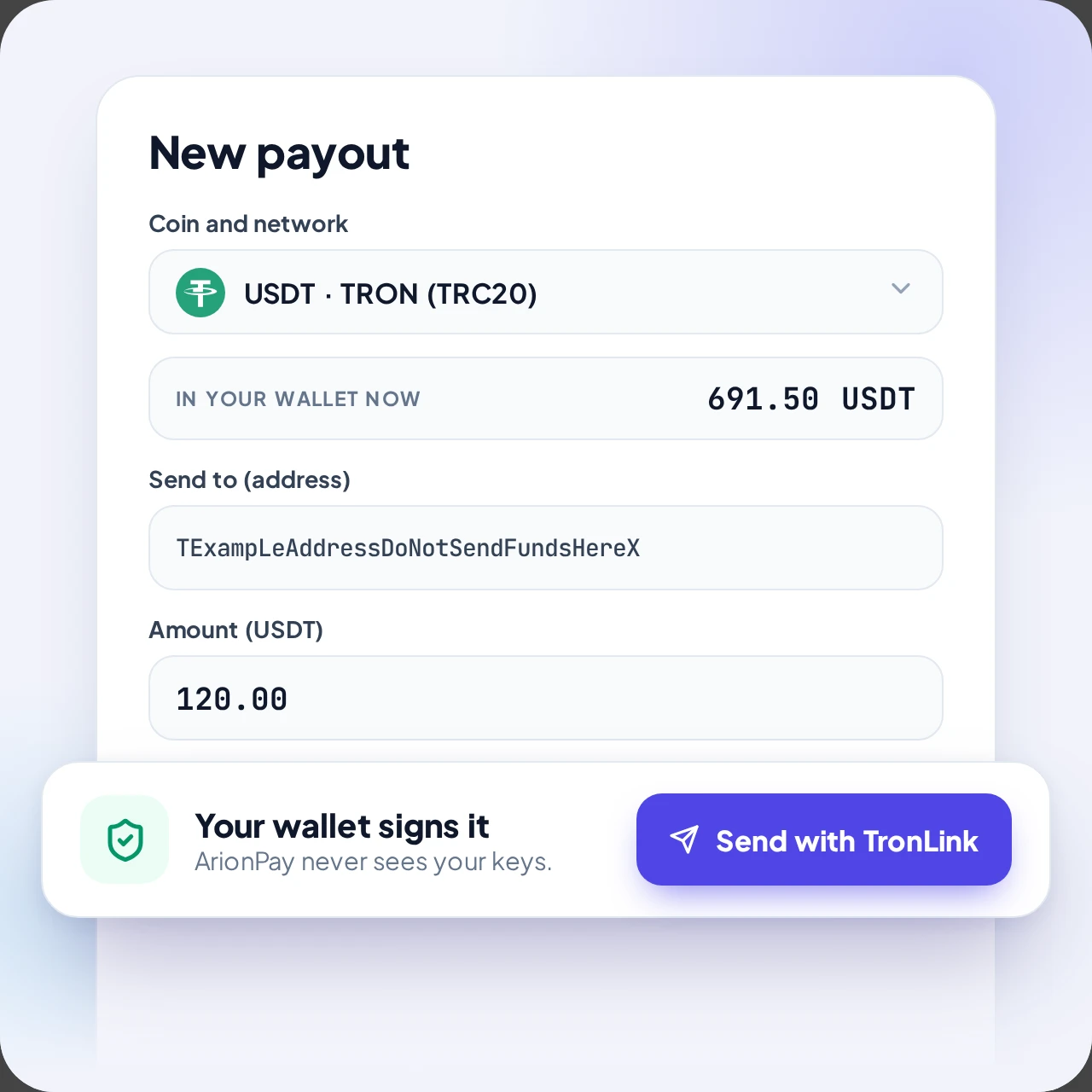
Only your wallet can move your money
ArionPay stores only your public key, and it cannot spend. When you send a payout from your dashboard, your own wallet signs it.
Changing the wallet your payments go to needs a code from your authenticator app, and the change waits 24 hours.
Limits
What no gateway can protect
- Your 12 secret words. Whoever has them controls the money. If you lose them, nobody can restore them, including us. Keep them offline.
- Stablecoin freezes. Tether and Circle can freeze USDT and USDC at the token level. That happens outside any gateway.
- Irreversible payments. A blockchain payment cannot be pulled back. Refunds are new payments that you send.
- Phishing. We will never ask for your secret words, by email, chat or anywhere else.
Found a security problem?
Tell us privately before you tell anyone else, and give us time to fix it. We pay up to $1,000 for real findings. Bug bounty rules and rewards